
Work with cubes, slabs, wedges, corners, ridges, and other pieces that join cleanly for roofs, bevels, slopes, and mechanical forms.
Native Rust voxel craft
A free voxel and low-poly editor for artists who want shaped voxels, face-level texture painting, reference planes, layers, and fast export without fighting the tool.
FreeRust + wgpuWindowsmacOSLinuxiOS planned
Built for forms that cubes cannot express.
Kumiki is designed around fast native editing, clean low-poly shape language, and practical production workflows for indie games, prototypes, props, and dioramas.
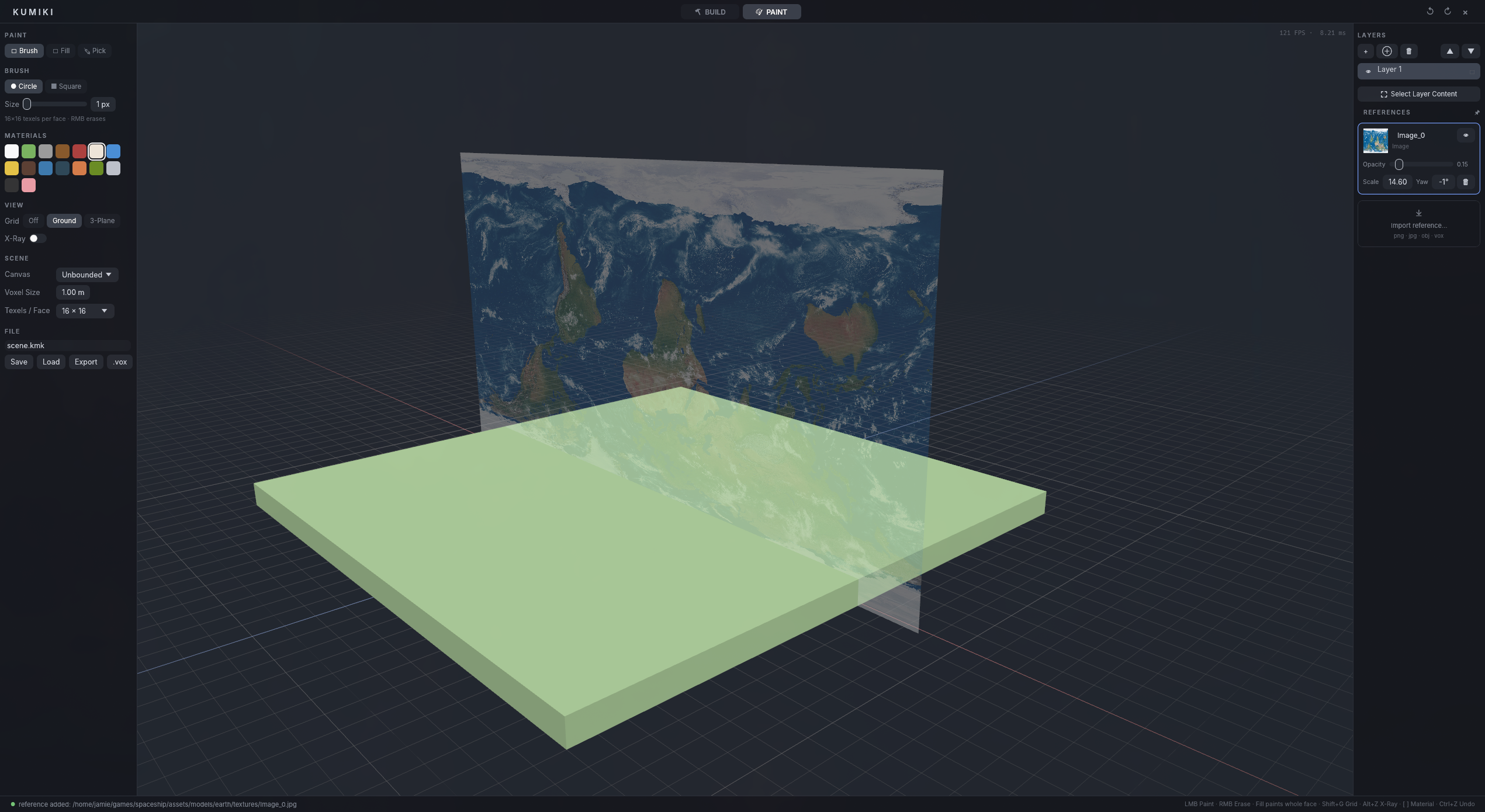
Switch from building to painting and place crisp texels directly on voxel faces with brushes, fills, material picking, and erasing.
Import blueprint images or model references into the viewport, then tune opacity, scale, and rotation while you build against them.
Written in Rust with a wgpu renderer, Kumiko aims for responsive editing on large scenes without dragging a browser runtime around.

Build mode
Place, erase, select, and transform voxel forms with grid-aware tools and a palette made for structured low-poly models.
Paint mode
Treat each face like a tiny canvas for pixel-art detail, decals, material blocking, and quick color passes.
Layered scenes
Keep parts separated, hide or reorder layers, and select entire layer contents when a model needs to move as a unit.
Export-ready direction
The roadmap targets practical game pipelines with glTF and .vox workflows instead of tool-specific dead ends.
Desktop first. Cross-platform by design.
Kumiki is being built as a native editor for the major desktop platforms, with iOS planned once the core workflow is stable.
DesktopWindows
DesktopmacOS
DesktopLinux
PlannediOS
Follow the build.
Kumiki is early, but the editor is already taking shape around the workflows voxel artists keep reaching for: references, layers, low-poly pieces, texture painting, and fast iteration.